Introduction
Healthcare is the only industry where “regulatory innovation” is a phrase that people say without irony. There are plenty of tech-driven breakthroughs, and just as many businesses built around new CMS rules and pilots.
Indeed, one of the biggest – if rarely talked about – healthcare shifts of the past fifty years was not a new technology but rather a new profession: The Advanced Practice Provider or APP, a segment of the healthcare workforce that includes nurse practitioners (NPs) and physician assistants (PAs).
Like traditional doctors, NPs and PAs can order prescriptions and labs and manage panels of patients, though they are subject to some prescribing restrictions and MD supervisory requirements that vary by state. NPs, who are the larger and more autonomous of the two groups, can practice independently in ~30 states. PAs always operate with a degree of MD supervision.
How the NP role in particular came to be, the obstacles it faced, and how it scaled to the far corners of care delivery, sheds light on the path we can expect clinical AI to take. In fact, the laws governing practice of medicine, professional licensing, and prescribing authority that NPs had to navigate and ultimately fight to change, are the very same ones that clinical AI startups are seeking regulatory relief from in state pilots.
Let’s start with the history. First introduced in the 1960s, APP roles were originally conceived of as a way to address rural access gaps while heading off sharply rising demand from the newly insured following the passage of Medicaid and Medicare. Today there are 461,000 nurse practitioners and more than 200,000 physician assistants, representing more than a third of the country’s prescribing capacity, and delivering as much as a quarter of all Medicare visits, up from just 14% in 2013. But both roles remained relatively rare until the 1990s.
Licensed and Employed NPs by Year
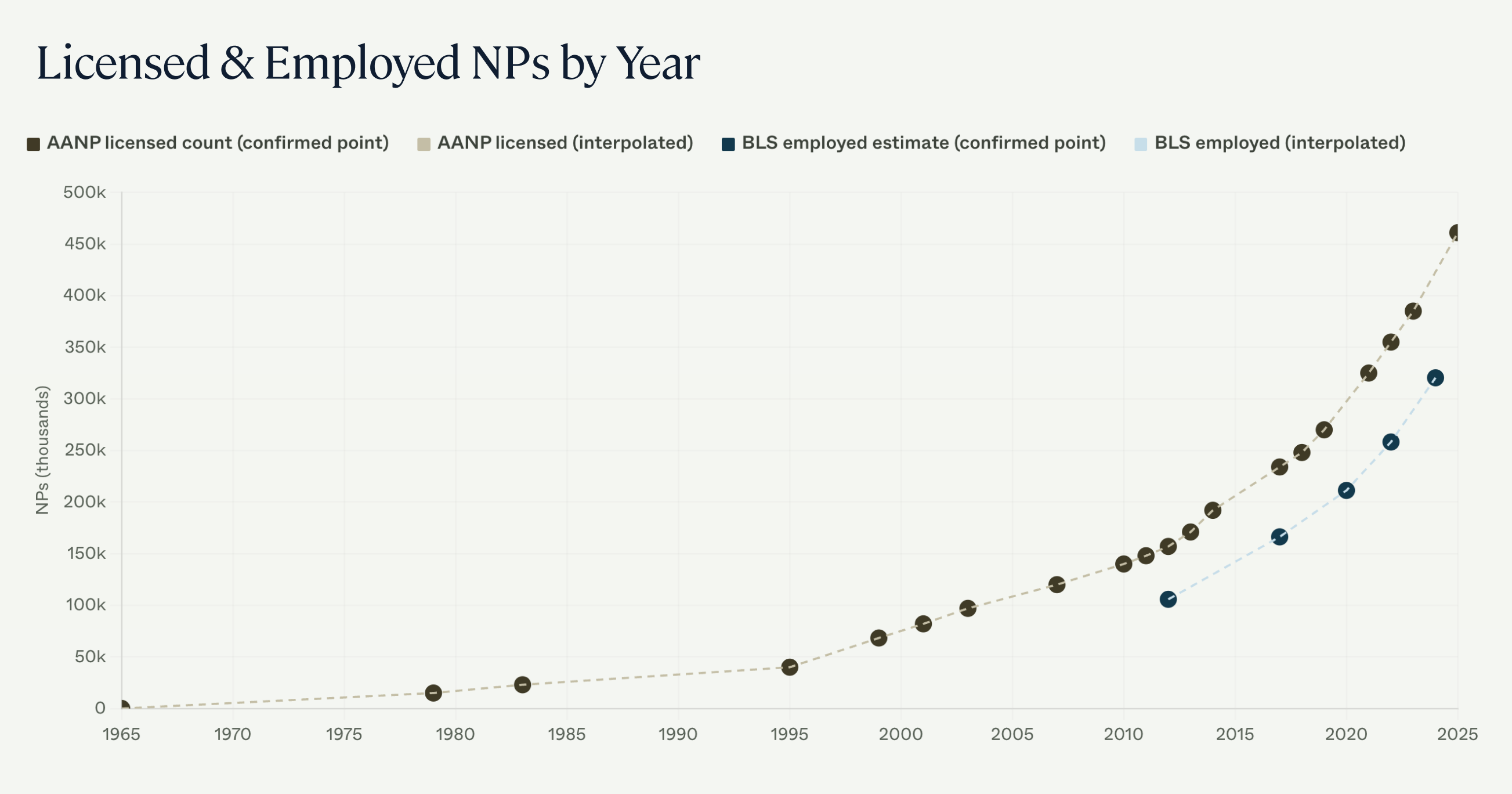
Why did it take so long to reach the mainstream and what allowed them to get there? The answer is nuanced but it boils down to six main factors:
- They had to convince state legislators to grant practice authority
- They had to win favorable legal precedents
- They needed reimbursement pathways (especially from Medicare)
- They needed published clinical evidence
- They needed centralized bodies to govern licensing and own advocacy
State lobbying
From the beginning (and in every decade since) APPs have met fierce resistance from the medical establishment. A couple of examples:
- In 1987, there were 3,000 NPs in the state of New York, many of them practicing in a regulatory gray zone. For five years, they advocated for a bill that would allow them to practice with MD supervision, but the bill fell apart as the issue became what an NP spokesperson termed "a political football.'' Push back came from two main sources: the Medical Society of the State of New York wanted the bill to require a master’s degree in all cases. The Nurses Association wanted lawmakers to confer benefits on nurses more broadly.
- The episode echoed a drama that played out a decade earlier in New Jersey in 1979. PAs had been advocating for more autonomy and were thwarted by the New Jersey Nurses Association and the Medical Society of New Jersey. The opposition's arguments, as summarized by the New York Times, were “there was no need for another level of medical care, that there was an adequate supply of nurses and physicians to care for patients, that the P.A. would not provide relief to a doctor because the assistant would have to be supervised constantly and that the assistants would actually be doing things that only a doctor should.”
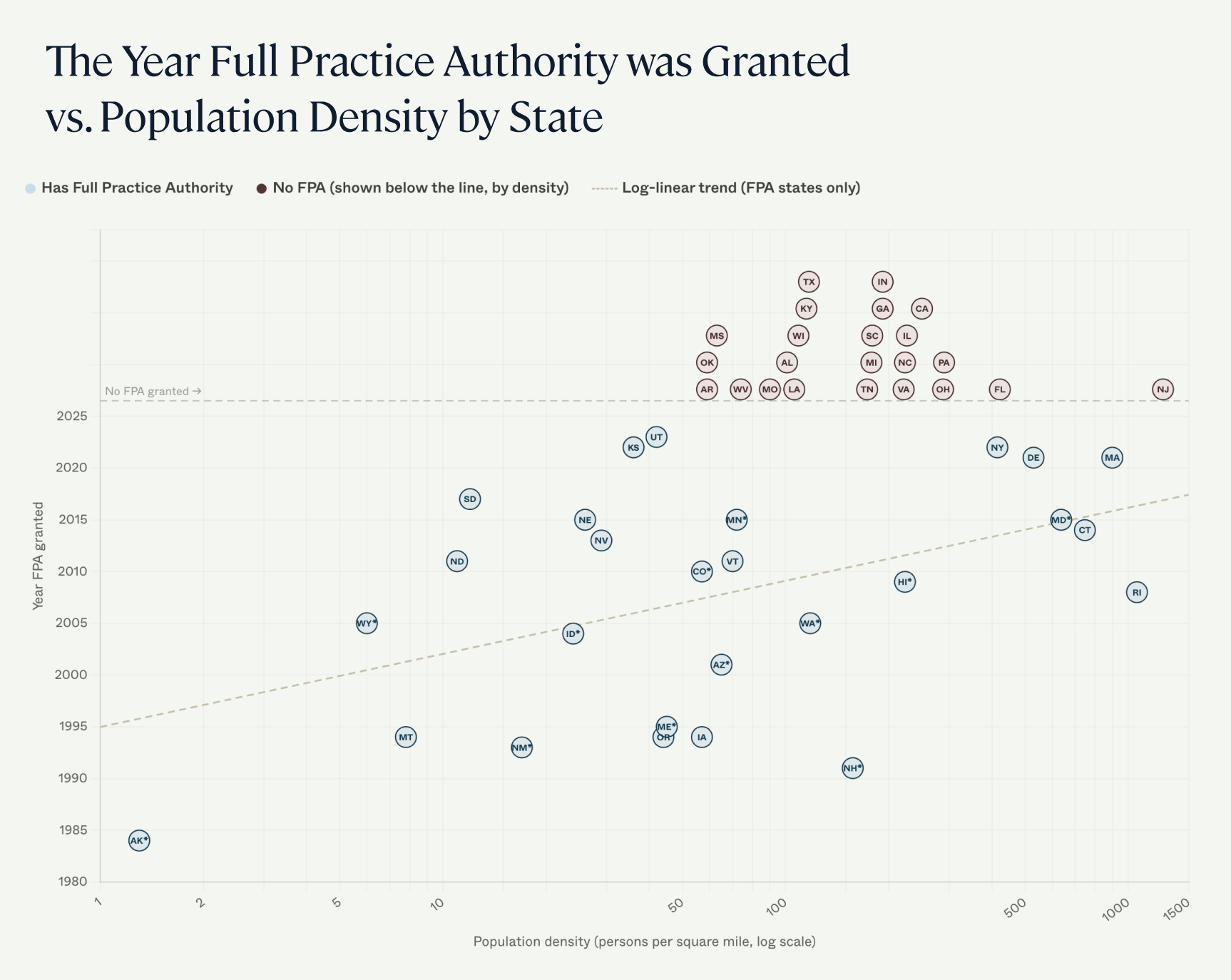
For NPs, the most successful strategy in winning over states has been to focus on the role as one way to address access gaps – in the beginning, pediatric primary care was a focal point, now it’s primary care more broadly – especially in under-served patient populations. It should come as no surprise then that rural states were among the first to grant full practice authority to NPs.
The year full practice authority was granted vs. population density
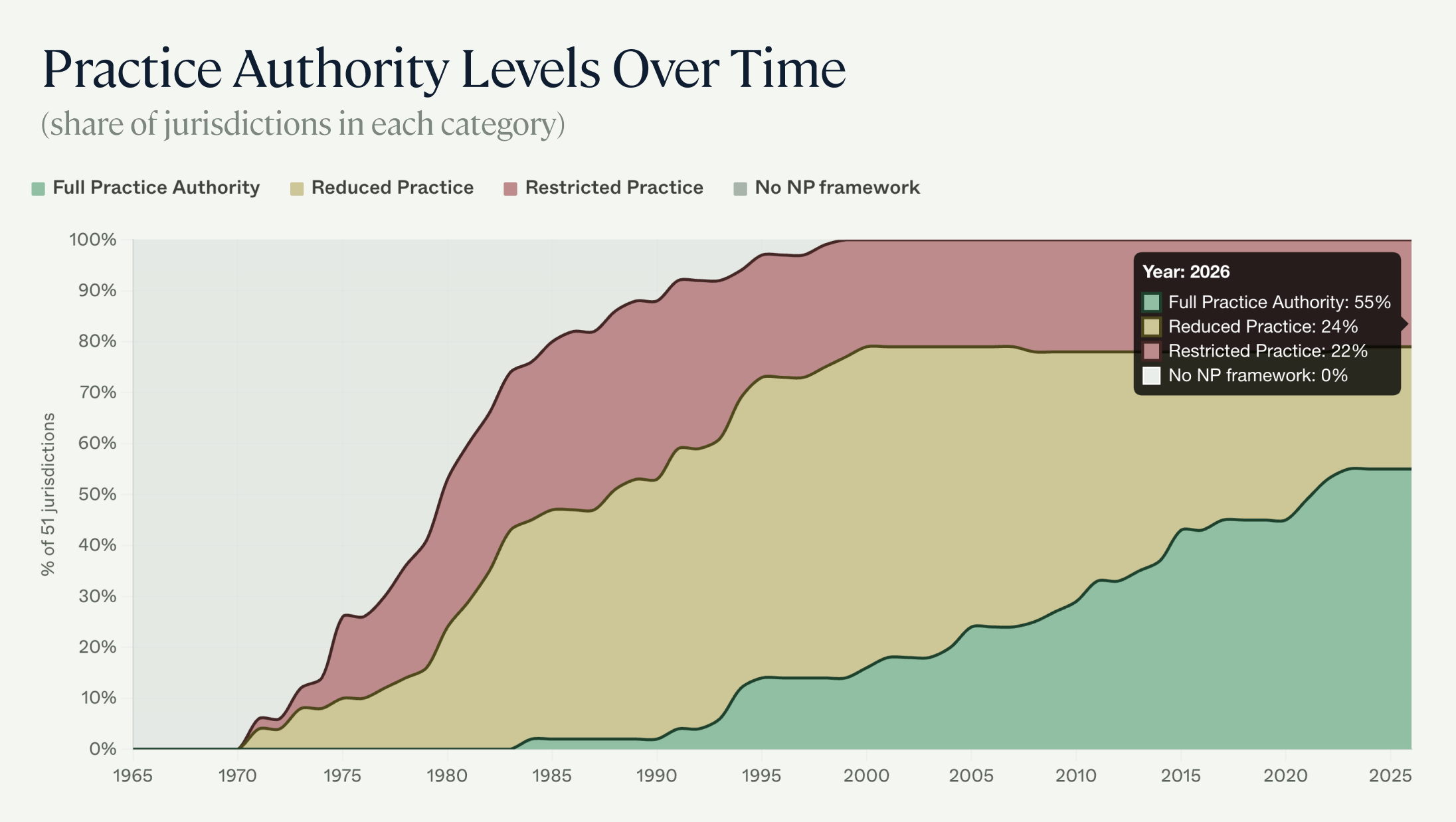
NP practice authority levels over time by % of states in each category
Legal precedent
The path to mainstream status for NPs didn’t come from sweeping federal reform so much as a steady accumulation of state legislation and a series of court decisions that clarified what counted as the “practice of medicine.” A case in point is Sermchief v. Gonzales (Missouri, 1983), in which the state supreme court rejected the argument that protocol-driven advanced nursing care constituted unauthorized medical practice. Instead, it held that activities like examination, assessment, and even treatment – when performed under structured protocols – fell within the legitimate scope of professional nursing as defined by Missouri state law even if there was overlap with a doctor’s purview.
Another case, Fein v. Permanente Medical Group (California, 1985), centered on a lawsuit from a patient who'd suffered a heart attack after being seen by a nurse practitioner and then by a doctor. During the proceedings, the trial court instructed the jury that “the standard of care required of a nurse practitioner is that of a physician and surgeon ... when the nurse practitioner is examining a patient or making a diagnosis." In a bit of convoluted legal wrangling, this was later taken up as an issue by the defendant on appeal, but the net effect of the eventual ruling was to recognize many NP responsibilities as physician-like but falling within the scope of professional licensing for nurses under California state law.
Overtime, the legal questions have evolved from whether NPs could practice at all to where the boundaries of that practice should be drawn – what procedures, titles, or privileges were still reserved for physicians? A recent case in California centers on whether NPs who’ve earned a doctorate degree can adopt the prefix of “doctor” when talking to patients (the courts seem to be leaning toward saying they cannot though their ruling has been appealed).
Reimbursement
Court decisions established that NPs could practice, but reimbursement policy determines the circumstances in which there is financial support for them to do so.
In 1977,the Rural Health Clinic Service Act specified that services provided by NPs and PAs could be reimbursable by Medicare in rural health settings, with appropriate oversight from an MD.
The next inflection point came with the 1998 CMS rule implementing the Balanced Budget Act, which allowed nurse practitioners to bill Medicare directly in a variety of care settings.
The ability to seek direct reimbursement, albeit at a lower rate (typically 85% of what an MD bills), opened up new possibilities, such as the ability to launch and run an independent practice or to act as the clinician running point in a primary care setting.
Later, regulatory changes built on this progress. The 2012 CMS hospital Conditions of Participation rule allowed hospitals to grant NPs medical staff membership and clinical privileges.
Together, these shifts increased the potential for compensation but also conferred legitimacy. They recognized NPs as independent suppliers in the eyes of Medicare, the largest payer in the country, which often sets the standard for how private health insurance companies approach provider contracting.
Clinical evidence
In a series of studies, NPs have, by all appearances, demonstrated clinical performance that rivals MDs, often at a lower cost.
A study published in 2023 found that the removal of MD supervision had no impact on medical malpractice claims against NPs. Likewise, this analysis by an insurer shows a lower volume claims per clinician for NPs than MDs, though this may be due to differences in the populations they treat. Another found that NP prescribing patterns were just as safe as those of MDs when caring for seniors.
The body of evidence behind the NP role is now considerable and was a necessary investment in establishing the profession.
Today nearly every successful VBC provider group from One Medical for Seniors to Oak Street makes extensive use of NPs in their care team, in part as a way of stretching their resources to provide proactive support to complex patients without compromising quality. Along with PAs, they are the lifeblood of Urgent Care and can be found in nearly every Minute Clinic across the country.
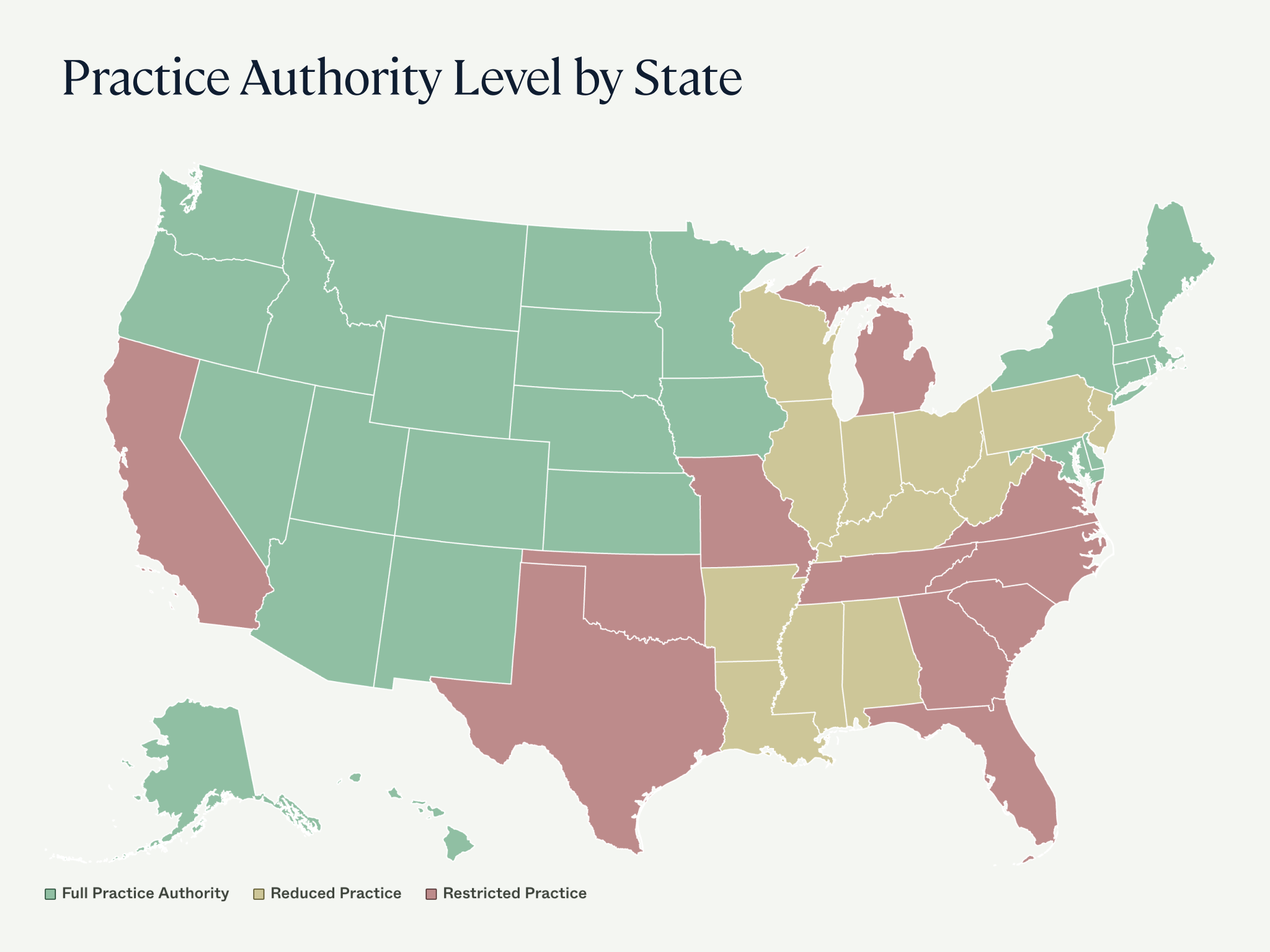
Practice authority by state
Centralized governance
In 1985, the American Academy of Nurse Practitioners was created. The reason, as one of its founders, Jan Towers, put it: “There weren’t very many of us NPs in those days. We were a bunch of mavericks, learning to do things beyond the traditional scope of a registered nurse (RN)...We needed to have our work become legally recognized, which led to health policy.” In 2013, it merged with the American College of Nurse Practitioners (founded in 1995) to become the American Association of Nurse Practitioners (AANP).
Technically, the American Nursing Association (ANA) speaks for all nurses including NPs, but in representing a much broader set of stakeholders, the most populous of which is RNs, its objectives are more diverse, with less of an emphasis on the unique challenges of forging an entirely new and at times controversial clinical role.
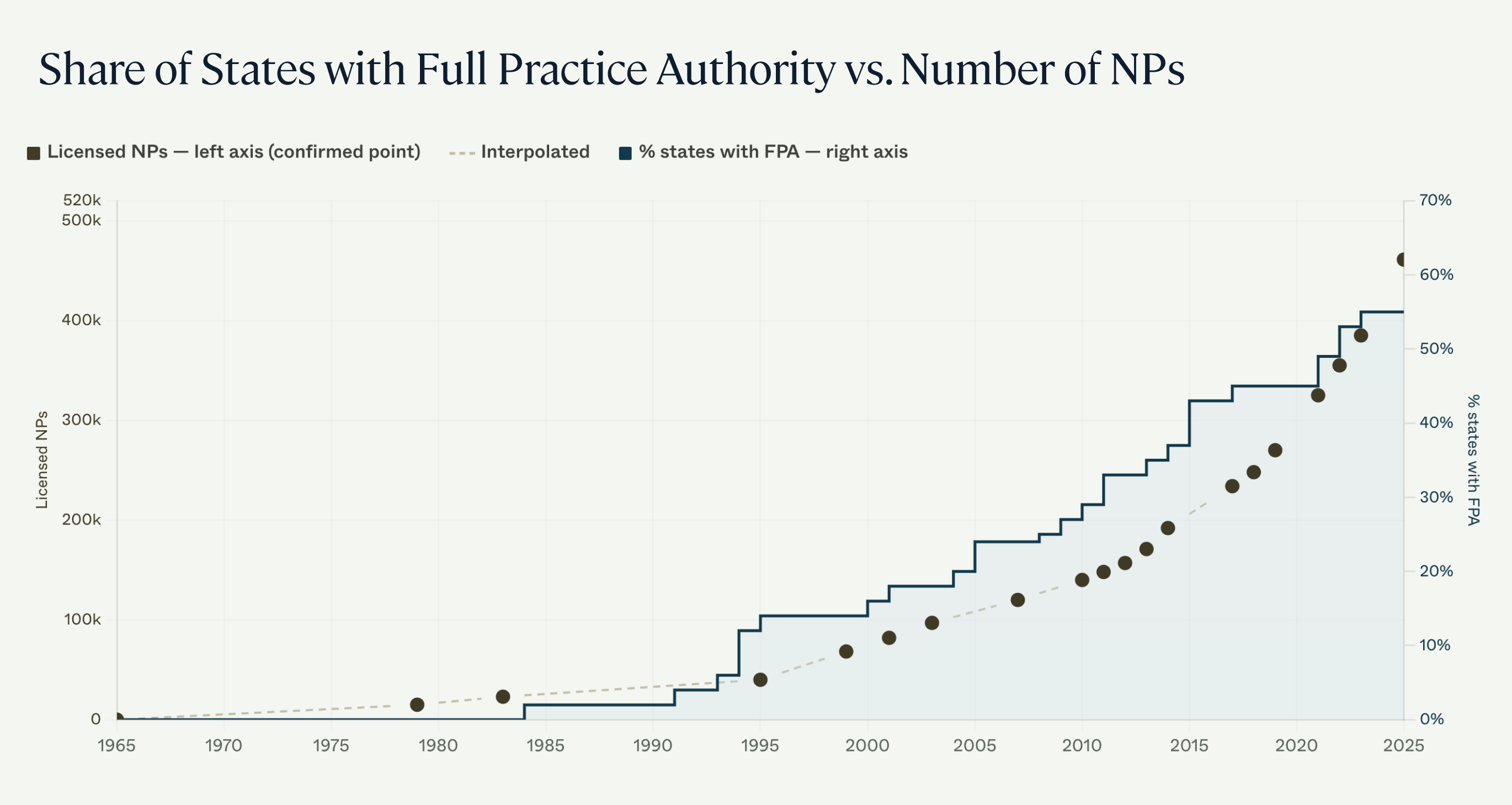
The AANP is funded by membership dues, which creates a sort of flywheel: the more successful they are in advocacy, the more the NP profession grows, the more funding they have to amplify their agenda. You can see this at work in how the ranks of NPs ramped up dramatically in the past 15 years: every year since 2011 has produced at least one new full practice authority state.
Beyond advocacy, the AANP played a critical role in mobilizing and publicizing research to establish a clinical evidence trail, defining certification and continuing education requirements, and promoting the formation of training programs.
Share of states allowing full practice authority vs. number of NPs
What does this tell us about what to expect with clinical AI?
There are many potential parallels and take-aways:
- Like it or not, there’s an inherent tension in healthcare innovation. If you allow incumbent medical bodies to gate-keep innovation, they may naturally lean toward slowing it. However, if you completely cut them out of the process, there’s a chance of innovators taking risky short-cuts.
- Early adoption will precede legal clarity. NPs were often practicing in gray zones in the early years – sometimes explicitly outside statutory authority – before laws caught up. The same dynamic is already happening in clinical AI: startups are testing the legal boundaries of software-as-a-medical device and practice of medicine while also seeking out sandboxes that provide the cover they need to build the case for expansion.
- The regulatory regime for the practice of medicine, a patchwork of state rules, imposes long delays. For NPs, it took a slog of national and local advocacy over multiple decades to gain regulatory acceptance. Successful advocacy depended on forming governance bodies, aligning on and centralizing certification requirements, and collecting and publishing data demonstrating equivalence. Of course, every time the profession assumed new responsibilities, new data was needed (not unlike how new FDA clearances and evidence generation may be needed as autonomous AI expands its repertoire). Clinical AI has CHAI and Alliance for AI in Healthcare (AAIH), but no group yet that seems to purely channel the interests of the disruptors.
- Just as important as new state statutes are the series of tests that clinical AI will inevitably face in the courts. Success will depend on eking out narrow but favorable clarifications of existing law that legitimize AI-delivered care while addressing the fears that deter potential clinical AI builders from wading into uncertain regulatory territory. A good analogy is self-driving cars, which have seen their first raft of lawsuits. The ambiguity surrounding them has given rise to new legislation such as California’s recent bill which allows cps to issue traffic violations to autonomous vehicle manufacturers.
- Regulatory sandboxes enable experimentation, but widespread deployment will hinge on reimbursement. Ultimately what matters is whether payors – especially CMS – decide to reimburse AI-enabled clinical work, at what rate, and under what conditions. This is the lesson that CMS is putting into action in how it has set reimbursement for ACCESS (at a rate that many have said is only viable for AI-native solutions). While there is movement on the fee-for-service front (see musings on SaMS in the OPPS 2027 rule) efforts to introduce AI-delivered care will more often center on VBC or VBC-like arrangements. Which is to say, while NPs are reimbursed at 85% of an MD in traditional Medicare, it is unlikely we will reimburse AI as an offset to MD rates. AI is constrained only by demand, not by supply, heightening the risk of excess utilization.
- Mainstream acceptance in healthcare is a multi-stakeholder juggling act. At some point, the benefits of including NPs and PAs in care models and steadily expanding their authority became apparent to lawmakers, hospital administrators, and healthcare disruptors; MDs embraced them in many settings; and their role has gradually been normalized for consumers. All of this paved the way for assimilation, but it was a glacial process. The question is: what will this look like for an innovation like AI that has fewer clear precedents?
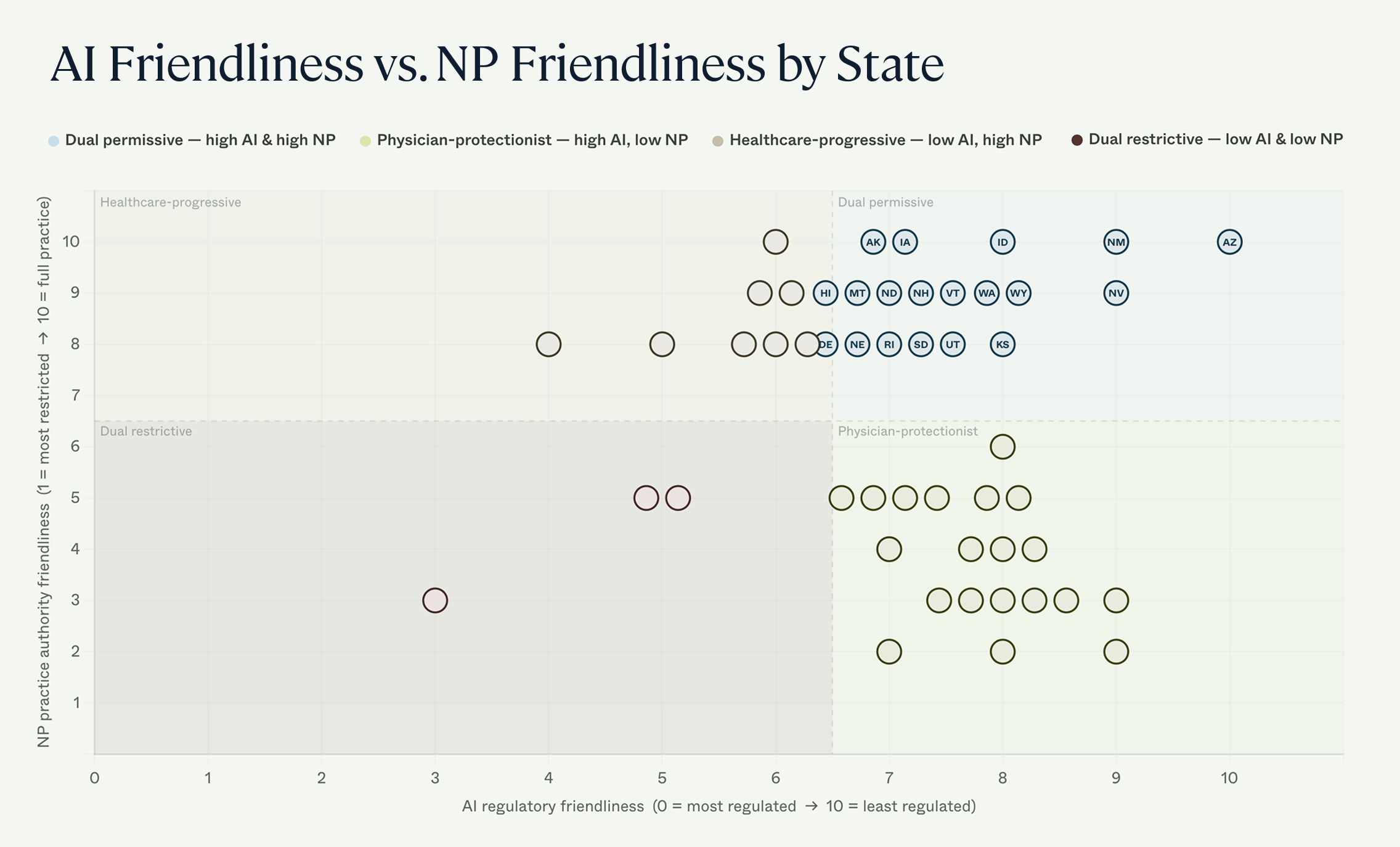
- Given the role of state regulation, autonomous clinical AI is likely to find early acceptance in parts of the country that sit at the intersection of two policy positions:
- States that have shown a willingness to experiment with new clinical roles (such as NPs)
- States that have avoided passing laws that prohibit the use of AI, in healthcare or otherwise.
AI friendliness vs. NP friendliness by state
Federal regulation
The analogy is imperfect, but if you think of AI agents as simply the latest addition to the care team, just as NPs did not replace doctors but rather carved out their own important role with areas of overlap and distinction, clinical AI will too. At the federal level though, the regulatory journey may look a bit different:
- Clinical AI is subject not only to state law, but also FDA authority. Similar to how the FDA ensures the safety of medical devices, it is also responsible for what’s known as software-as-a-medical device (SaMD) – software that plays a diagnostic or therapeutic role. The modern SaMD framework was developed in the early2010s, at a time when software products were typically more static (rules based or feature engineered), self-contained (no AI lab APIs under the hood), and validated prospectively prior to deployment. As a result, these systems were generally easier to evaluate and slower to change than today’s AI systems.
- While there are emerging efforts to modernize this framework – such as programs like TEMPO or ARPA-H funding initiatives – the regulatory system is still largely built around premarket validation of semi-static products that are installed or implemented by hospitals or doctors. The FDA has begun exploring lifecycle-based approaches for systems that are inherently adaptive, but many applications of clinical AI may still require costly validation (and re-validation as models evolve). These costs could be borne by payors and patients in the form of per visit fees, a corollary of how drugs, whose marginal manufacturing costs are typically low, can end up with very high prices.
- Arguably the thorniest issue to be worked out is legal responsibility. Who’s on the hook if an autonomous clinical AI system makes a mistake? A faulty drug or medical device can be recalled. MDs and NPs who make mistakes can lose their license, face malpractice claims, or expulsion from Medicare reimbursement. These and other actions are reported to the National Practitioner Databank, which was established by Congress in 1986, as a national clearinghouse for medical professionals that follows them from job to job and across state lines. Will this be expanded to encompass AI care delivery companies too?
- There’s one source of favorability on the federal front: the federal government controls medical authority within the VA specifically (as far back as the 1970s, the VA made use of NPs in admissions, and by the late 1990s, nearly every VA medical center offering primary care had at least one NP). Will we see the current administration capitalize on this to create its own version of an AI sandbox? Or will they focus their energy on persuading states to standardize around a clinical AI friendly policy framework? Time will tell.
In my next post, I’ll explore what happens if the regulatory barriers impeding autonomous clinical AI fall much more quickly than they did for nurse practitioners, and what the implications will be for care delivery and the many industries that support it.